Formerly known as V Bar V Heritage Site, the Crane Petroglyph Heritage Site is the largest known petroglyph site in the Verde Valley, as well as one of the best-preserved. Acquired by the Coconino National Forest in 1994, the site is protected and kept open to the visiting public for their enjoyment and opportunity to learn more about our national cultural heritage.
Here’s the original gate to the V Bar Ranch.

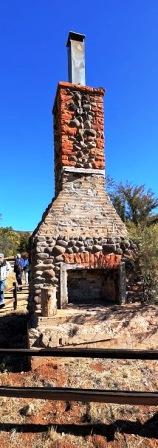
A fireplace and chimney are all that remains of the ranch.
It was a nice walk from the parking lot, near the V Bar sign to the actual petroglyph site. Here we are, on our way. Even though we had brilliant sunshine, it was cold! But there is nothing like clean, crisp desert air.

Petroglyphs are images created by removing part of a rock surface by carving or abrading as form of rock art. The Crane Petroglyphs were created by Southern Sinagua residents between about 1150 and 1400 AD. The site was known to early American settlers, and became part of a cattle ranch around the turn of the 20th century.
Here is an example of the petroglyphs.

The most fascinating thing about these petroglyphs is that they are much more than drawings in stone. They are actually part of a sophisticated calendar system. The big slash through the rock is actually a
actually a solar calendar that marked planting and harvesting cycles.

At this site, there were actually two calendars, the smaller one shown above and this larger one.

Have you ever seen petroglyphs? If so, where?




 Nancy Loderick's Blog
Ju-Lyn
April 7, 2025
You & MrKen are looking good! I love that you are exploring & adventuring. How is your shoulder recovering?
LikeLiked by 1 person
Nancy Loderick
April 8, 2025
Hi friend,
Thanks for your comment. Mr. Ken and I are having so much fun adventuring.
As for my shoulder, all is well. I’m still doing PT and will be doing it for another few months. It seems shoulder rehab is one of the longest.
Hope you are well.
Nancy
LikeLiked by 1 person
Ju-Lyn
April 17, 2025
I love your can-do spirit and that you are not letting injury stop you from adventuring on! Cheering you on towards complete healing.
LikeLiked by 1 person
Gary Donaldson
April 16, 2025
So fascinating! Still there after all these hundreds of years
LikeLiked by 1 person
Nancy Loderick
April 16, 2025
Hi Gary – thanks for stopping by my blog. 🙂
And I, too, find it so fascinating about how old these petroglyphs are.
Nancy
LikeLike